Spend ten minutes in the comments under any news story about Muslim women’s clothing and you’ll see the same three words used as if they were interchangeable. Hijab. Niqab. Burka. They’re not interchangeable. They describe garments that cover different amounts of a person, come from different parts of the world, and in some cases have almost nothing to do with each other beyond a shared reason for existing.
That confusion isn’t harmless, either. Laws get written about “the burka” in countries where practically nobody wears one. So it’s worth getting the vocabulary straight.
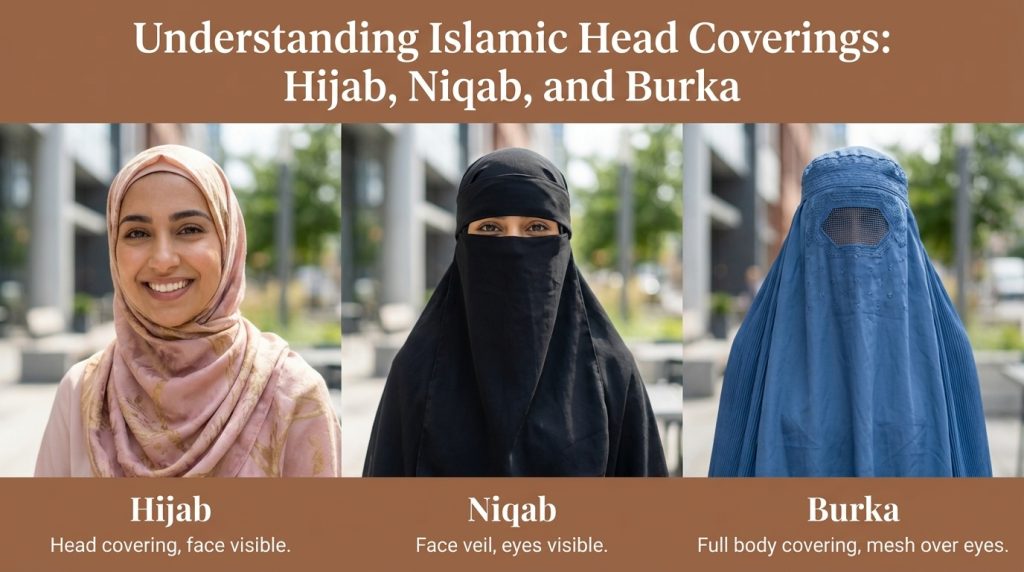
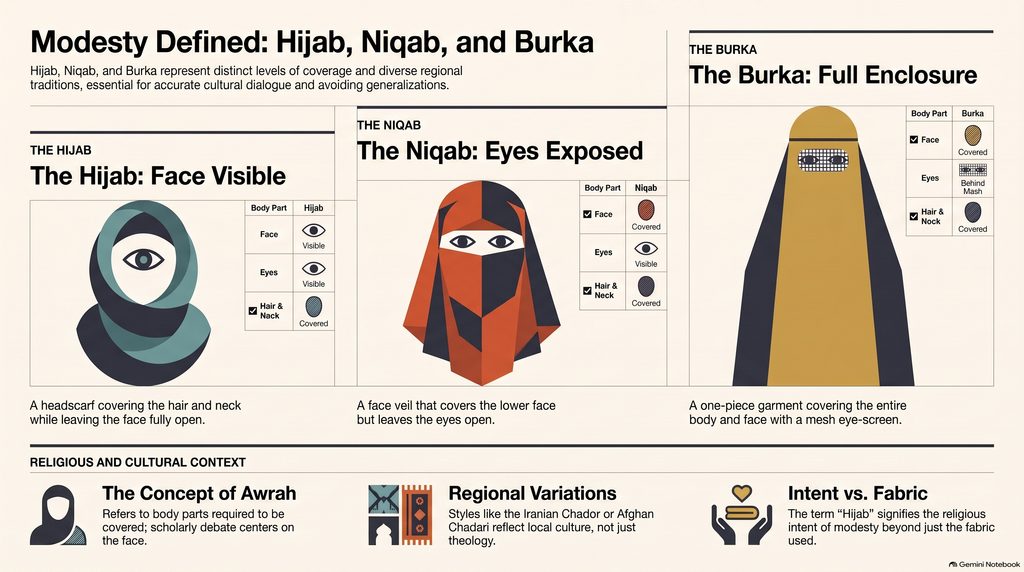
Here’s the short version before we get into it: a hijab covers the hair and leaves the face open. A niqab covers the face but leaves the eyes open. A burka covers everything, eyes included, with a mesh panel to see through.
Now the longer version.
Hijab

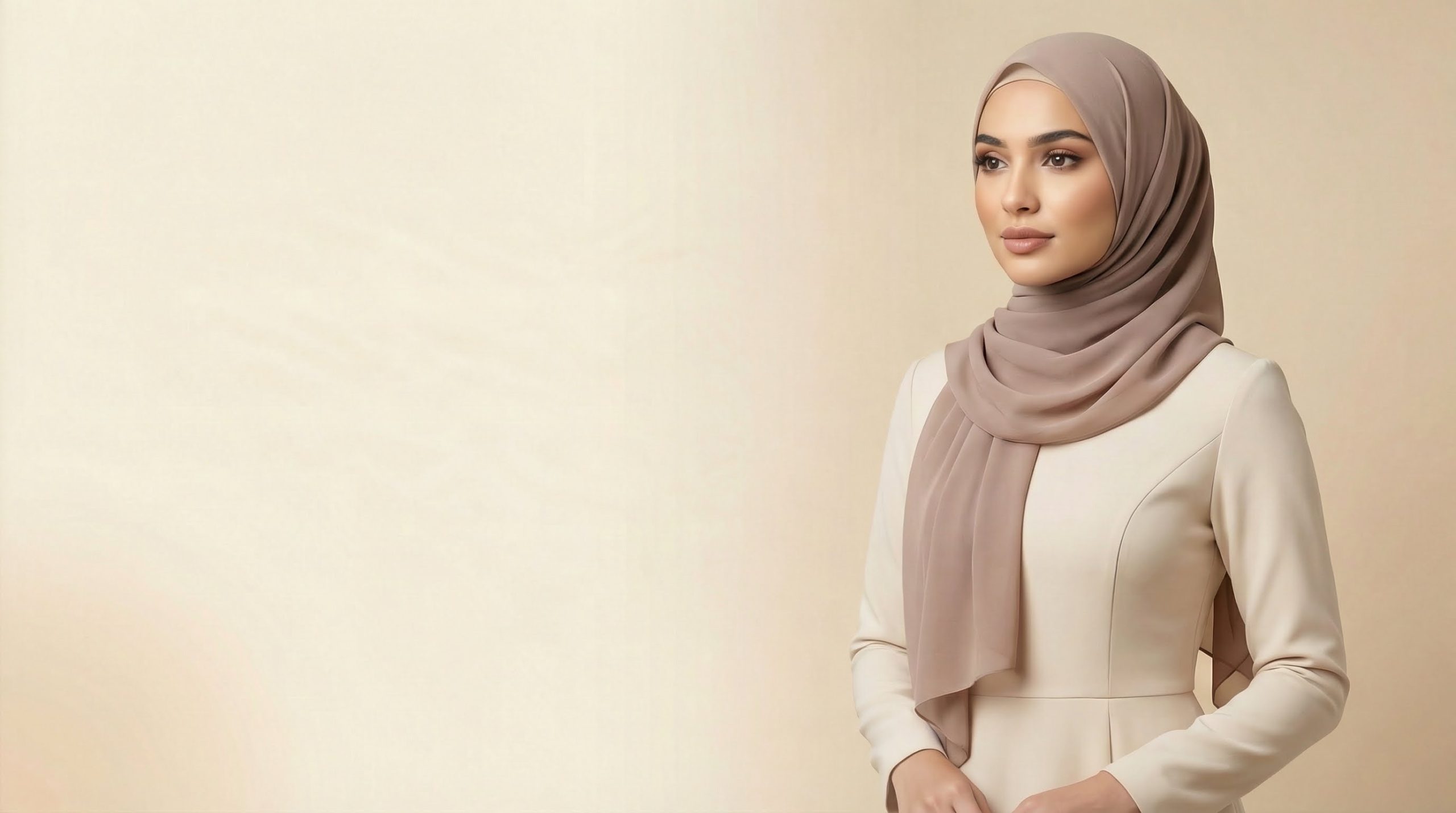
If someone says “Muslim headscarf” in English, this is almost always what they mean. It wraps around the head to cover the hair, ears and neck, usually draping over the shoulders. The face stays completely visible.
It’s the most common of the three by a wide margin. You’ll see it in Jakarta, Detroit, Cairo, Lagos, Birmingham — on doctors, students, athletes, women running errands. There’s an entire fashion industry built around it now, which twenty years ago barely existed.
A few styles worth knowing by name:
Shayla : A long rectangular scarf, wrapped around the head and tossed or pinned over one shoulder. Popular across the Gulf.
Al-amira : Two pieces — a fitted cap plus a tube-shaped scarf that slips over it. It stays put without pins, which is why it’s the default for schoolgirls and anyone in a hurry.
Khimar: A cape-like veil cut in a semicircle, falling to the waist or lower. It covers the chest as one piece rather than needing a separate layer.
Chador : Worth mentioning because people mistake it for a burka. It’s an Iranian full-length cloak, open at the front, held closed by hand or under the arm. The face is uncovered.
One linguistic note that trips people up. The Arabic root of hijab — h-j-b — means to screen or partition. In the Qur’an the word actually refers to a curtain, not to clothing. The garment terms used in the text are khimar and jilbab. Somewhere along the way “hijab” became the catch-all English label for the headscarf, and it stuck.
Is a hijab the same as a headscarf? Physically, more or less. The difference is intent. A woman wearing a scarf against the wind is wearing a headscarf. A woman wearing one as a religious practice is wearing hijab. Same fabric, different thing.
In Indonesia and Malaysia the everyday word is jilbab, which means something different in Arabic — an outer cloak. Regional vocabulary shifts, and that’s normal.
Niqab
The niqab is a face veil. It covers the lower face and is worn with a headscarf, so the hair, neck and face are concealed while the eyes stay open and uncovered.
Two main cuts:
Full niqab runs from just below the eyes down over the chin, often with a separate band across the forehead, leaving a horizontal opening for the eyes. Common in Saudi Arabia, Yemen and the Gulf.
Half niqab ties below the eyes and covers from the nose down, leaving the forehead and eyes exposed. You see this more in Pakistan, Bangladesh, Egypt and parts of East Africa.
Most women who wear niqab pair it with an abaya or a similar loose outer robe, so the overall silhouette doesn’t show body shape. Colors are usually dark, though that’s convention rather than rule — plenty of women wear patterned or colored versions.
The niqab is a separate garment you put on. That’s the practical distinction people miss when they call it a burka.
Burka

This one is the most misused word of the three.
A burka — also spelled burqa — is a single all-in-one garment that goes over the head and falls to the ankles. There’s no opening for the eyes. Instead there’s a rectangle of woven mesh sewn in at eye level, and the wearer looks out through it. Everything else is enclosed.
It’s regional, not universal. The style most people picture comes from Afghanistan, where it’s usually called a chadari rather than a burka. Its construction is genuinely impressive craftsmanship: a fitted embroidered skullcap at the crown, with hundreds of narrow pleats radiating down from it, plus the separate mesh face panel. The pale blue version became the international shorthand image, though they’re also made in white, brown, green and grey.
Pakistan and northern India have their own versions — the pleating is softer, often done with running stitch or honeycomb smocking, and the front panel can usually be lifted back over the head when the wearer wants it off her face.
Then there’s the battoulah, sometimes called a burka in the Gulf and Iran — a stiff, gold-toned mask covering the brow, nose and upper lip. Completely different object, same word attached to it. Mostly worn by older women now.
So when someone asks about the difference between a burqa and a hijab, the honest answer is that they’re barely comparable. One is a scarf. The other is an entire enclosing outer garment from a specific corner of Central and South Asia.
And the difference between a burka and a niqab? The eyes. Niqab leaves them open. A burka doesn’t.
Hijab vs Burka vs Niqab
| Body Parts | Hijab | Niqab | Burka / Burqa |
|---|---|---|---|
| Hair | Covered | Covered | Covered |
| Neck | Covered | Covered | Covered |
| Shoulders | Covered | Covered | Covered |
| Lower face | Visible | Covered | Covered |
| Eyes | Visible | Visible | Behind mesh |
| Body | Worn with regular modest clothes | Usually worn with an abaya | Enclosed by the garment itself |
| Hands | Visible | Usually visible, sometimes gloved | Covered by the fabric |
| Number of pieces | One | Two or more | One |
Where the religious disagreement actually sits
Underneath all of this is a concept called awrah — the parts of the body a person is expected to keep covered in front of others, with different standards depending on who’s present. It applies to men too, incidentally, just with a narrower scope.
The scholarly argument isn’t really about whether modest dress is required. It’s about where the boundary falls, and specifically whether the face is inside it or outside it.
Hanafi and Maliki scholars have generally held that a woman’s face and hands are not awrah. Under that reading, covering the hair is obligatory and covering the face is not — it’s permitted, sometimes praised, but not required.
Positions within the Shafi’i and Hanbali schools have leaned the other way, with a number of scholars holding that the face should be covered in front of unrelated men, either as a firm obligation or as strongly recommended.
That’s a compressed summary of centuries of legal writing, and the internal variation within each school is real. But it explains something useful: two women can be equally devout, equally informed, and land in different places on face covering, because the tradition itself lands in different places.
There’s also plenty of contemporary Muslim scholarship arguing the headscarf itself isn’t obligatory, which is another live conversation entirely.
Culture does as much work as theology
Worth saying plainly: a lot of what gets read as religious signaling is regional dress.
The Afghan chadari existed before it was framed as a religious requirement, and it was tied to class and urban respectability as much as piety. A Turkish woman’s scarf-tying style and a Somali woman’s are recognizably different from across a room. Modest dress in Nigeria doesn’t look like modest dress in Oman.
Family, geography, generation, personal taste, and what your friends wear all feed into it. Faith is one input among several.
The part that gets left out
Most articles like this end by saying the choice is personal. Which is true, and also a bit too tidy.
The honest picture is messier. Some women choose freely. Some are pressured by family. Some are legally required to cover — Iran and Afghanistan being the obvious cases. Some are legally forbidden from covering, in France, Belgium, Denmark and elsewhere, where face-covering bans carry real penalties. Some started young and reconsidered later. Some took it off and put it back on.
What all those situations have in common is that the woman involved usually has a clearer account of her own reasons than anyone speculating about her does.
If you take one thing away, make it the vocabulary. Hijab covers hair. Niqab covers the face and leaves the eyes. Burka covers everything. Getting those three right is a low bar, and clearing it will already put you ahead of most of the conversation.
Is it haram to not wear a hijab?